Bruce Pearl
The Boston College team manager who won a Division II title at Southern Indiana, then revived Tennessee overnight: six straight NCAA Tournaments, the program’s first No. 1 ranking in 2008, and its first Elite Eight in 2010.
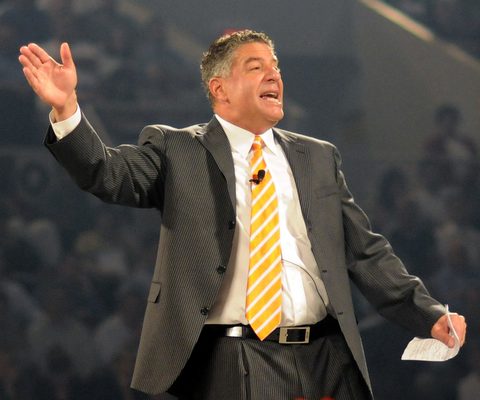
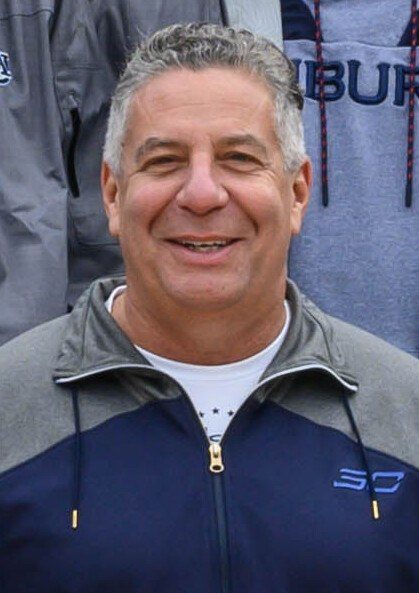
A Manager Who Became a Coach
Bruce Alan Pearl, a Boston native who grew up in Sharon, Massachusetts, never played college basketball — a shoulder injury ended his playing days in high school football — but at Boston College he served as student manager of Tom Davis’s basketball team, and after graduating in 1982 he followed Davis as an assistant at Stanford and then Iowa. His first head coaching job, at Southern Indiana in 1992, brought a Division II national championship in 1995 and NABC Division II Coach of the Year honors.
Milwaukee
At Milwaukee from 2001, Pearl won two Horizon League regular-season and tournament championships and, in 2005, took the Panthers to the Sweet Sixteen — the run that made him Tennessee’s choice to succeed Buzz Peterson, announced on March 28, 2005.
The Revival
Pearl installed an up-tempo, pressing style on a roster built around C. J. Watson and Kentucky native Chris Lofton, and the improvement was instant: a 22–8 record, an SEC East title and a No. 2 NCAA Tournament seed in year one, with two wins over eventual national champion Florida. Attendance at Thompson–Boling Arena jumped by more than seven thousand fans per game. His teams reached the Sweet Sixteen in 2007 and again in 2008, when the 31–5 Volunteers won the SEC regular-season championship and, after beating Memphis, rose to No. 1 in the national polls — the first No. 1 ranking in program history. In 2010 Tennessee beat Ohio State to reach the Elite Eight, the deepest tournament run in school history, and lost to Michigan State by a point, 70–69. Pearl’s teams reached the NCAA Tournament in all six of his seasons.
The Fall
In 2010 Pearl was found to have violated NCAA recruiting restrictions by inviting a high school prospect and his family to a cookout at his home in the summer of 2008, and to have misled NCAA investigators about it. Tennessee suspended him for the first half of the 2010–11 SEC season, and after the season, in March 2011, the university fired him. The NCAA imposed a three-year show-cause penalty, and Pearl spent the interval as a television analyst and as a vice president of marketing for a Knoxville grocery wholesaler.
Auburn
Auburn hired Pearl in March 2014, months before his show-cause expired, and he rebuilt the Tigers into a national power, reaching the Final Four in 2019 and again in 2025. He retired in September 2025 as Auburn’s winningest coach, having led two different SEC programs — Tennessee and Auburn — to a No. 1 national ranking, a feat no other SEC head coach in football or men’s basketball has matched.
Season by Season
| Season | Overall | Conference | Postseason |
|---|---|---|---|
| 2005-06 | 22-8 | 12-4 | NCAA Second Round |
| 2006-07 | 24-11 | 10-6 | NCAA Sweet Sixteen |
| 2007-08 | 31-5 | 14-2 | NCAA Sweet Sixteen |
| 2008-09 | 21-13 | 10-6 | NCAA First Round |
| 2009-10 | 28-9 | 11-5 | NCAA Elite Eight |
| 2010-11 | 19-15 | 8-8 | NCAA Second Round |
| Career — 6 seasons | 145-61 | 65-31 | 6 NCAA appearances (2010 Elite Eight; 3 Sweet Sixteens) |
Photographs: U.S. Air Force photo by Master Sgt. Kurt Skoglund, public domain, via Wikimedia Commons; United States Naval Academy Photo Archive, public domain, via Wikimedia Commons.