Pat Summitt
The defining coach in women’s basketball history: 1,098 wins, eight NCAA championships and 38 seasons at Tennessee, all of it built from a $250-a-month job she took at 22.

Early Life and Playing Career
Patricia Sue Head was born on June 14, 1952, in Clarksville, Tennessee, to Richard and Hazel Albright Head, and grew up on a dairy farm, playing basketball from age six on a hoop her father had installed in a barn. Known as Trish in her early years, she had three older brothers and a younger sister. When she reached high school, her family moved to nearby Henrietta so she could play basketball in Cheatham County, because Clarksville had no girls’ team.
She went to the University of Tennessee at Martin and won All-American honors playing for Nadine Gearin, UT Martin’s first women’s basketball coach. Title IX was still two years away when she arrived in 1970, and there were no athletic scholarships for women; her brothers had received them, and her parents paid her way. As a player she co-captained the United States team at the inaugural women’s Olympic basketball tournament in Montreal in 1976, winning the silver medal.
Head Coach at 22
Just before the 1974–75 season, with women’s college basketball still in its infancy and not yet an NCAA-sanctioned sport, 22-year-old Summitt came to the University of Tennessee as a graduate assistant — and was named head coach of the Lady Vols after Margaret Hutson stepped down. She earned $250 a month and washed the players’ uniforms, uniforms purchased the previous year with proceeds from a doughnut sale. “I had to drive the van when I first started coaching,” she later recalled. “One time, for a road game, we actually slept in the other team’s gym the night before.”
Four of her first players were only a year younger than she was. She coached her first game on December 7, 1974, an 84–83 loss at Mercer, and won her first on January 10, 1975, 69–32 over Middle Tennessee State. That first team went 16–8 and won the Tennessee College Women’s Sports Federation Eastern District Championship for the third straight year.
Building the Program
Through the late 1970s, while earning her master’s degree in physical education, Summitt turned a club-era program into a national one. Tennessee recorded its first 20-win seasons, won back-to-back AIAW Region II championships, defeated three-time AIAW champion Delta State by 20 points in 1978, earned the program’s first No. 1 ranking, and reached the AIAW Final Four. The Lady Vols won the first-ever SEC tournament in 1980 and finished as AIAW runner-up in both 1980 and 1981.
When the NCAA held its first women’s tournament in 1982, Tennessee was in it — and in every one that followed for the rest of Summitt’s career. The Lady Vols reached the Final Four in 1982, the championship game in 1984, and the Final Four again in 1986, building the foundation, and the expectation, that a title was a matter of time.
Eight National Championships
The breakthrough came in 1987: Tennessee beat Louisiana Tech 67–44 in Austin for the program’s first national championship, with Tonya Edwards named the Final Four’s Most Outstanding Player. A second title followed in 1989, a 76–60 win over Auburn capping a 35–2 season, and a third in 1991, when the Lady Vols outlasted Virginia 70–67 in overtime.
The middle of the 1990s brought a second wave: a fourth title in 1996, beating Georgia 83–65 after an overtime semifinal win over Connecticut, and a fifth in 1997. The last two championships came back-to-back in 2007 and 2008 behind Candace Parker, the Final Four’s Most Outstanding Player both years — the eighth title, a 64–48 win over Stanford on April 8, 2008, closed the count. Eight NCAA championships in all: 1987, 1989, 1991, 1996, 1997, 1998, 2007 and 2008, alongside 16 SEC regular-season championships and 16 SEC tournament championships.
39–0: The 1997–98 Season
The 1997–98 team was, by wide agreement, Summitt’s best. Built around Chamique Holdsclaw and the nation’s top-ranked recruiting class, with freshmen Tamika Catchings and Semeka Randall, the Lady Vols ran the table against one of the toughest schedules in the country: 39–0, and only three opponents all season came within 10 points. The championship game was a 93–75 win over Louisiana Tech, and Louisiana Tech’s coach, Leon Barmore, called the Tennessee team the “best ever.”
It was Tennessee’s third consecutive national championship, completing the three-peat of 1996–98. The season became the subject of Summitt’s book with Sally Jenkins, Raise the Roof. The 1996–97 title that preceded it had been nearly as improbable the other way: a team that lost 10 games caught fire in March, stunned undefeated Connecticut in the regional final, and beat Old Dominion for the championship.
1,098 Wins
Summitt’s milestones accumulated like seasons. Her 100th win came in 1978, her 500th in 1993, her 700th in 1999. On March 22, 2005, a 75–54 NCAA tournament win over Purdue was her 880th victory, breaking Dean Smith’s record and making her the winningest coach in NCAA basketball history, men’s or women’s. On February 5, 2009, a 73–43 win over Georgia at Thompson–Boling Arena was win No. 1,000; she was the first NCAA coach to reach the mark.
She finished with 1,098 wins against 208 losses in 1,306 games across 38 seasons — at her retirement, the most wins in college basketball history. Her teams appeared in every NCAA tournament from 1982 onward, reached 18 Final Fours, and never had a losing season. Every Lady Vol player who completed her eligibility at Tennessee under Summitt graduated with a degree, and every one of them played in at least one Elite Eight.
The Announcement and the Final Season
In August 2011, Summitt announced that she had been diagnosed three months earlier with early-onset Alzheimer’s disease. “There’s not going to be any pity party, and I’ll make sure of that,” she said. She coached the 2011–12 season in a reduced role, with her longtime assistant Holly Warlick assuming most of the coaching responsibilities, and in December 2011 she was named Sports Illustrated’s Sportswoman of the Year.
The final team went 27–9, won her 16th SEC tournament championship, and reached the Elite Eight, falling to unbeaten eventual champion Baylor. On April 18, 2012, Summitt stepped down at 59, ending a 38-year career, and was given the title Head Coach Emeritus. “I feel like Holly’s been doing the bulk of it,” she said. “She deserves to be the head coach.” That summer she received the Arthur Ashe Courage Award at the ESPYs and the USBWA’s Most Courageous Award, which has been given in her name ever since.
Legacy
The honors had begun long before the ending. Summitt was inducted into the Women’s Basketball Hall of Fame in 1999 as a member of its inaugural class, into the Naismith Memorial Basketball Hall of Fame in 2000 — the same year she was named the Naismith Coach of the Century — and into the FIBA Hall of Fame in 2013. As the United States’ head coach she had won Olympic gold at Los Angeles in 1984, making her the first U.S. Olympian to win a basketball medal as a player and coach a medal-winning team. In 2012 President Barack Obama awarded her the Presidential Medal of Freedom, the nation’s highest civilian honor.
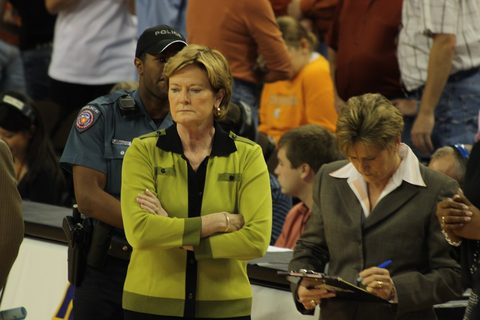
Tennessee named its court for her in her coaching lifetime: after win No. 880 made her the game’s winningest coach in March 2005, the Thompson–Boling Arena floor was christened “The Summitt” in a surprise postgame ceremony, her signature set into the sideline. An eight-foot bronze statue of her was erected on campus in 2013. Known for the icy “Summitt Stare,” for scheduling the nation’s toughest opponents on purpose, and for a coaching tree that sent 45 of her former players into coaching, she reshaped what women’s basketball could be.
Summitt died on June 28, 2016, in Knoxville, two weeks past her 64th birthday. The Pat Summitt Alzheimer’s Clinic at the University of Tennessee Medical Center, funded by her foundation, carries her fight forward, and in 2017 the NCAA established the Pat Summitt Award in her name.
Season by Season
| Season | Overall | Conference | Postseason |
|---|---|---|---|
| 1974-75 | 16-8 | — | — |
| 1975-76 | 16-11 | — | — |
| 1976-77 | 28-5 | — | AIAW Final Four |
| 1977-78 | 27-4 | — | AIAW First Round |
| 1978-79 | 30-9 | — | AIAW Final Four |
| 1979-80 | 33-5 | — | AIAW Runner-up |
| 1980-81 | 25-6 | — | AIAW Runner-up |
| 1981-82 | 22-10 | — | NCAA Final Four |
| 1982-83 | 25-8 | 7-1 | NCAA Elite Eight |
| 1983-84 | 23-10 | 7-1 | NCAA Runner-up |
| 1984-85 | 22-10 | 4-4 | NCAA Sweet Sixteen |
| 1985-86 | 24-10 | 5-4 | NCAA Final Four |
| 1986-87 National Champions | 28-6 | 6-3 | NCAA Champions |
| 1987-88 | 31-3 | 8-1 | NCAA Final Four |
| 1988-89 National Champions | 35-2 | 8-1 | NCAA Champions |
| 1989-90 | 27-6 | 8-1 | NCAA Elite Eight |
| 1990-91 National Champions | 30-5 | 6-3 | NCAA Champions |
| 1991-92 | 28-3 | 10-1 | NCAA Sweet Sixteen |
| 1992-93 | 29-3 | 11-0 | NCAA Elite Eight |
| 1993-94 | 31-2 | 11-0 | NCAA Sweet Sixteen |
| 1994-95 | 34-3 | 11-0 | NCAA Runner-up |
| 1995-96 National Champions | 32-4 | 9-2 | NCAA Champions |
| 1996-97 National Champions | 29-10 | 8-4 | NCAA Champions |
| 1997-98 National Champions | 39-0 | 14-0 | NCAA Champions |
| 1998-99 | 31-3 | 13-1 | NCAA Elite Eight |
| 1999-00 | 33-4 | 13-1 | NCAA Runner-up |
| 2000-01 | 31-3 | 14-0 | NCAA Sweet Sixteen |
| 2001-02 | 29-5 | 13-1 | NCAA Final Four |
| 2002-03 | 33-5 | 14-0 | NCAA Runner-up |
| 2003-04 | 31-4 | 14-0 | NCAA Runner-up |
| 2004-05 | 30-5 | 13-1 | NCAA Final Four |
| 2005-06 | 31-5 | 11-3 | NCAA Elite Eight |
| 2006-07 National Champions | 34-3 | 14-0 | NCAA Champions |
| 2007-08 National Champions | 36-2 | 13-1 | NCAA Champions |
| 2008-09 | 22-11 | 9-5 | NCAA First Round |
| 2009-10 | 32-3 | 15-1 | NCAA Sweet Sixteen |
| 2010-11 | 34-3 | 16-0 | NCAA Elite Eight |
| 2011-12 | 27-9 | 12-4 | NCAA Elite Eight |
| Career — 38 seasons | 1098-208 | 317-44 | 31 NCAA Tournaments (every tournament, 1982-2012), 18 Final Fours, 8 championships, 5 runner-up finishes; 4 AIAW Final Fours and 2 AIAW runner-up finishes before 1982 |
Photographs: aaronisnotcool, CC BY 2.0, via Wikimedia Commons; Staff Sgt. Christina M. O'Connell (U.S. Army), public domain, via Wikimedia Commons.